Goto de Vin brings you handmade glasses.
We promote and celebrate the art and craft of Murano Glass and share this knowledge with those who appreciate wine and the “gesture” of handmade. Working with the historic glass furnaces of Murano, we design glasses that reveal the typicity and idiosyncrasy of wine. Inspired by artefacts from Roman glass, the Renaissance era of Murano glassmaking and classic designs from the 20th century, Goto de Vin brings you wine glasses that are beautiful and transparent, and which complement the wine without distracting from it.
At the jaws of Hell the artist slaves.
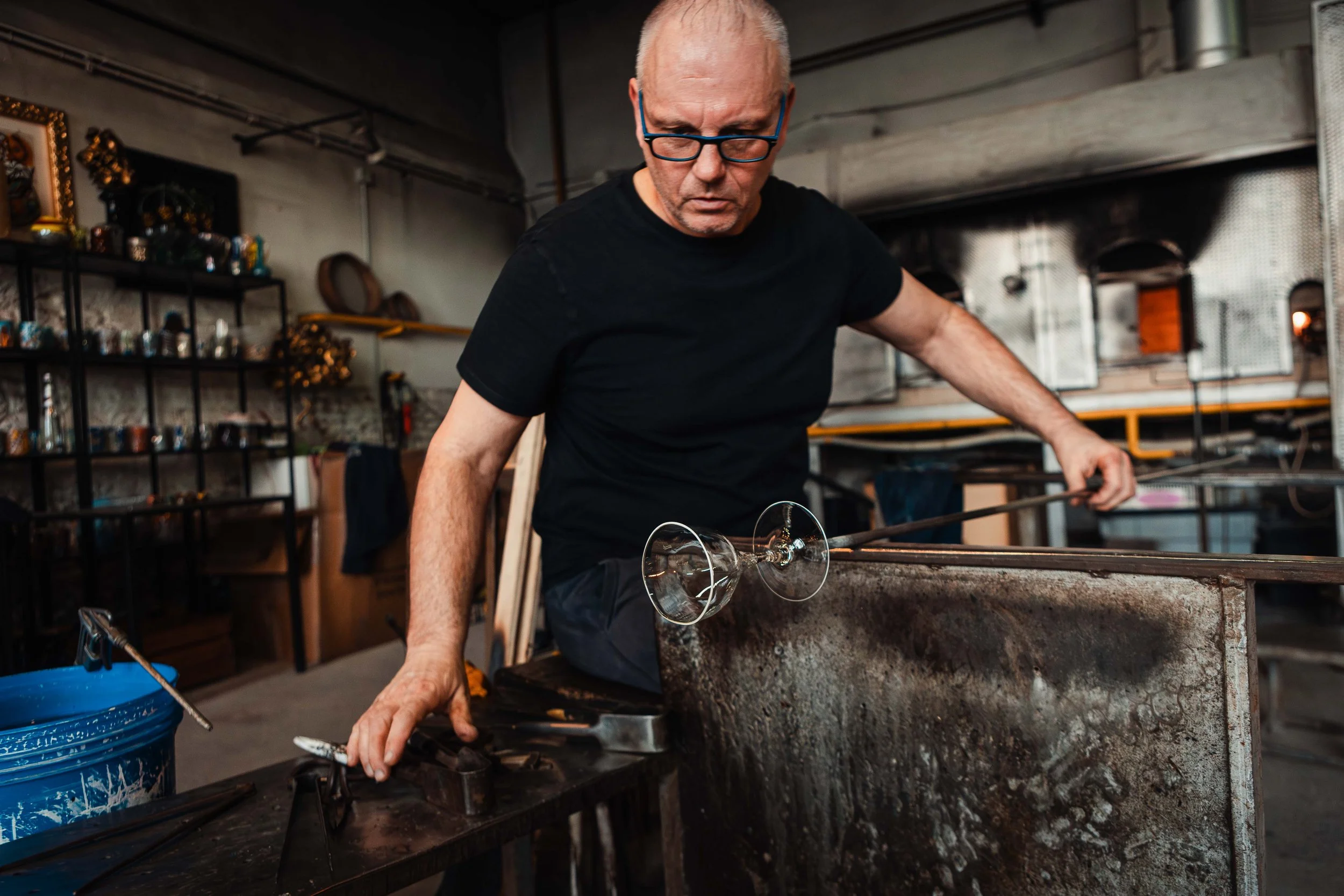
Diego Vio’s fiery furnace in Murano is the blazing heart of his work. He smelts crude glass to a thousand degrees, and from this molten crystal the master’s hands reveal shape after shape after shape. The tongs tease out form. The hot glass will shatter if not twirled in the oven constantly with nimble, heat-accustomed fingers. The rod swings like a sabre to elongate some detail with centrifugal force. The maker moves with effortlessly measured precision. The workshop sweats for ten hours a day, from before dawn to when the tired workmen leave. Mastering this inferno is no easy task. Vio has reached a pinnacle that few could have attained even with such hard work. He has devoted his life to glassblowing since the age of 14. At 21, he rented his own furnace. Now looking back from the peak of his career, he removes his spectacles and wipes his brow with a cloth. He is eager to demystify: “I have learned through trial and error. I’ve thrown away lots of glass.”
The stem and the cup are one piece.
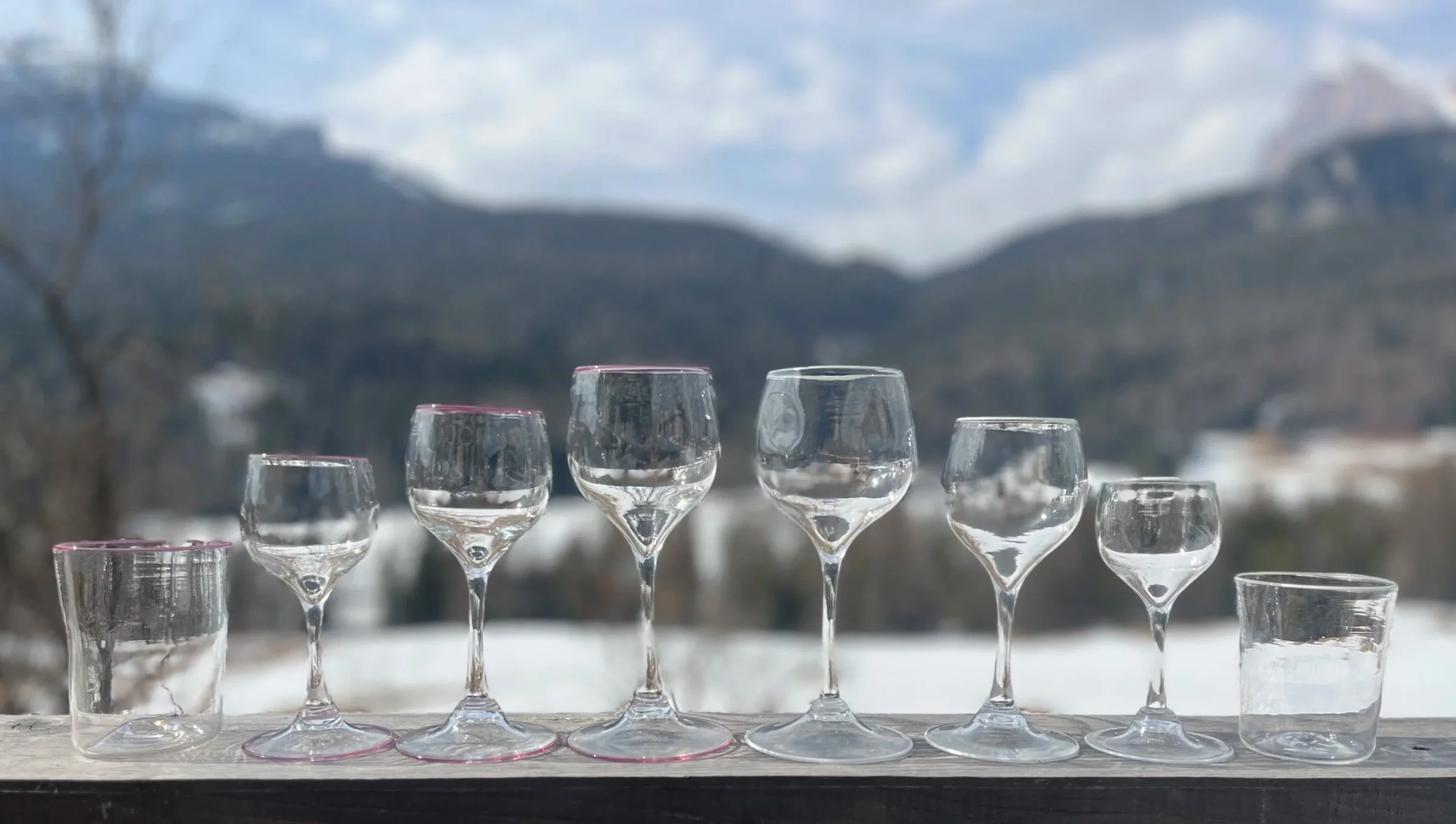
The designs we make together are simple and light, using colours in an understated way to decorate only the rim of each drinking vessel, framing the wine in the cup. Each goblet is ricavato or “obtained,” – sculpted, you might say – from a mess of crude glass that swims in the smelting cauldron. A hollow steel cane is dipped in and twirled. Air is introduced by blowing and expands to give the creation meaning, life and form: the cup. This means that only one joint is employed in the entire construction of the goblet, where the stem meets the disc that will rest on the table or counter. This base is decorated with a simple rim to match the cup above, executed with a fine filament of molten tinted glass, snipped to a controlled trickle and guided with a deft clip of the glass-master’s large iron scissors. This trickle reminds me of snow on the distant mountains outside the workshop’s window, facing the cemetery of San Michele and the Venice lagoon. The distant peaks are outlined with a little snow. Somewhere up there is Cortina. Hence the name.
Small cups to the brim.
The Cortina glasses are proportioned according to the modestly sized drinking vessels used in old-fashioned osterie in Venice, its hinterland, and in many other travelled towns in Italy and beyond. I have seen their relics in the cellars of old Burgundian castles. They are the cups of choice for those who trust their nose and palate, with no need for amplification. They are not rewards for large sums spent on bottles. Inns such as these still offer food and drink to restore the weary traveller, or workman, or idle philosopher, thief, poet or artist. Drink fills small cups to the brim. The ruby reflection glints in the smoky light. In these dens, the taste of the wine is fundamental. Structure takes precedence over smell, and quenches thirst and gives joy.
Lead balloons.
These days, the value placed on olfactory perception has reached its apogee. Giga-glassware from Germany, Austria and France is laced with lethal lead – a risk to the human glassblower – helping achieve gigantic proportions while retaining tensile strength. Machines and materials help replace the required dangerous skills. Lead balloons, sometimes compelling creations in their own way, populate restaurants, tasting rooms, and the imagination of many a sommelier. They are a far cry from the silver tastevin cup that used to dangle from the apron of the old cellarmaster of yore, examining bright wine’s reflection by candlelight in the troglodytic caves of the Middle Ages, beneath some storied vineyard. Some tools fall from favour, others change.
– Nikolai Navrozov
Our CortinaCollection
Available in 4 sizes, and 2 color variations: ruby and milk white rims
Hand blown by glassmaker Diego Vio in Murano, Venice (pictured above)
Get in Touch
If you're interested in finding out more about our handmade glasses please contact us.